

Why companies and farmers are rethinking how food is produced
Enger/Wolfenbüttel, June 22, 2026 – A project in Germany points to new models linking nature protection with business reality. Across the globe, agricultural landscapes are losing biodiversity at an accelerating pace – with direct consequences for crop yields, supply chains and economic stability. Yet despite its importance for food production and natural resources, biodiversity protection is still only rarely embedded in economic systems.
A project in Germany now illustrates how companies and farmers are trying to address this gap. The initiative, a joint effort by Mast‑Jägermeister SE and Kiebitz, links biodiversity measures directly to agricultural supply chains: companies finance targeted interventions on farmland, while farmers implement them and receive compensation in return.

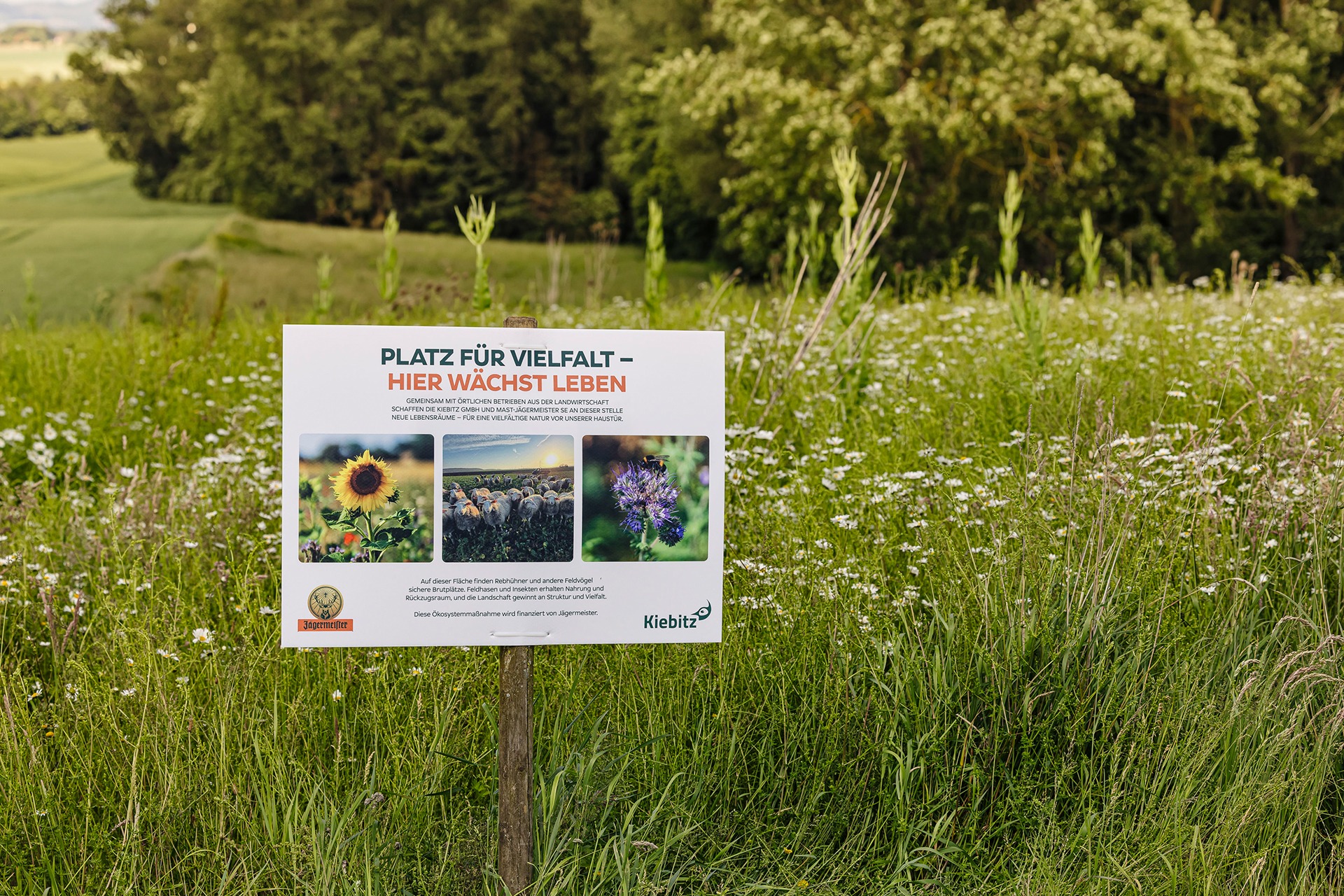
In the German region of East Westphalia-Lippe, measures such as flower strips, low-intensity cereal cultivation and dedicated habitat areas for wildlife are being implemented. These interventions aim to restore habitats for insects and birds while maintaining agricultural productivity.
A key challenge remains verifying impact. Biodiversity is widely regarded as difficult to measure, which has limited its role in business decision-making. To address this, the project uses a combination of established ecological measures and new monitoring technologies, including bioacoustic sensors and satellite data.
Initial results indicate significant effects: on the project fields near Enger, 57 bird species and more than 12,700 individual detections were recorded within a single spring. Bird activity was found to be six times higher than on comparable reference land without measures.
“Our role is to translate biodiversity measures into practical solutions that work in everyday farming,” said Dr. Ludwig Riedesel, Co-Managing Director of Kiebitz. “The key is to develop approaches that are ecologically effective while fitting into existing farming systems.”
For companies, biodiversity is no longer only seen as an environmental topic. The approach illustrates how closer collaboration between agriculture and business can open up new perspectives – and how companies can play an increasing role in supporting the protection of natural systems.